
Left Leg Varicose Vein Symptoms: Why They Appear More Often

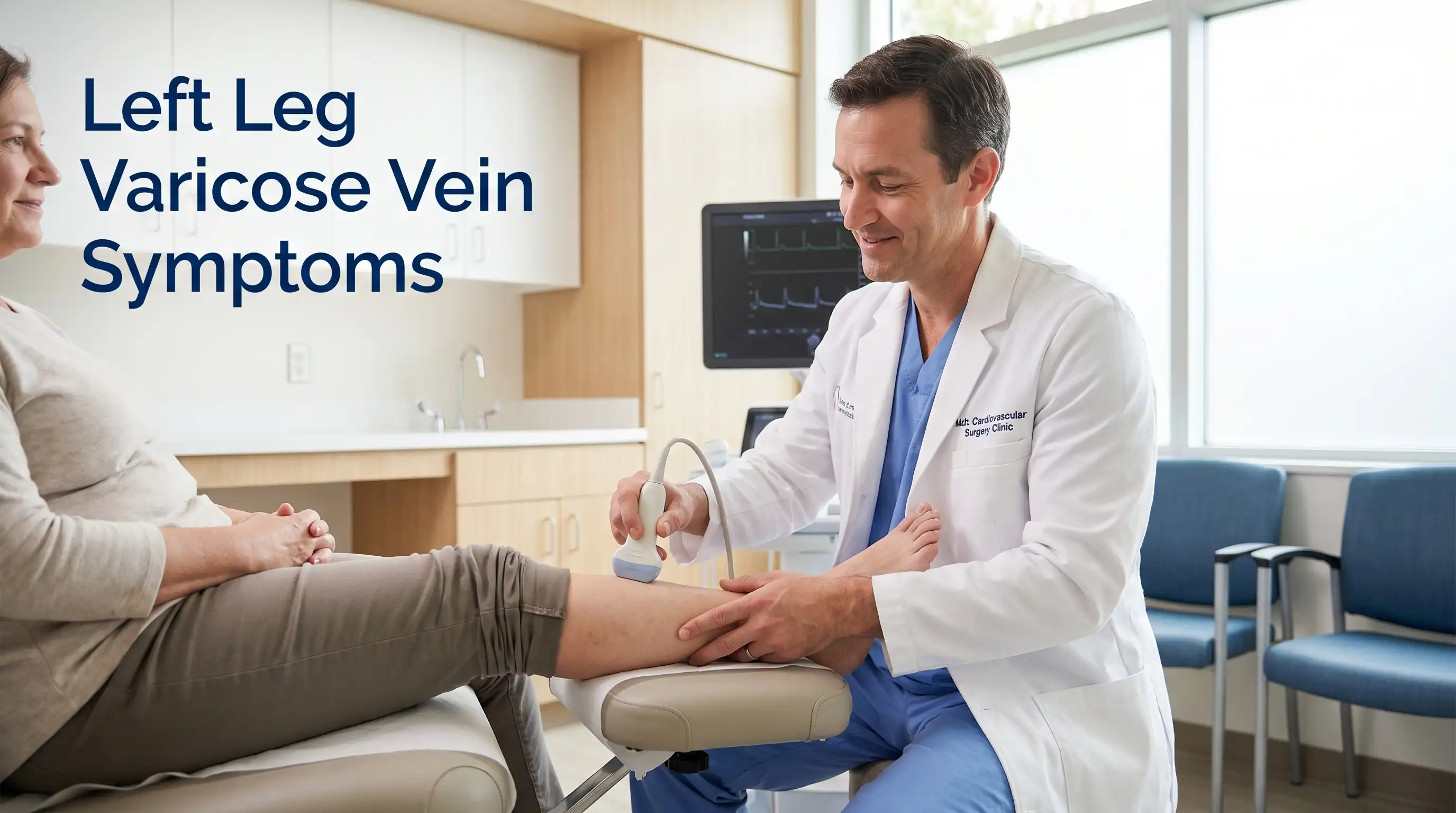
In my practice, most patients who come in for varicose veins share a striking pattern: their complaints typically start in the left leg or are noticeably more severe on that side. Over the years I have heard the question “Why is it always my left leg?” so many times that I decided to write this article. The answer is not simple coincidence. There is a critical asymmetry in the vascular anatomy of our body between the right and left legs, and this asymmetry naturally makes the left leg more vulnerable to chronic venous insufficiency.
Drawing on the questions I encounter most often in my clinic, this article will explain why varicose veins are more common in the left leg, which symptoms truly matter, an often overlooked condition called May-Thurner syndrome, the role of pregnancy and occupational factors, and the red flags that should prompt a visit to your doctor. My aim is not to alarm you but to help you read the signals your body is sending.
Why Are Varicose Veins More Common in the Left Leg? Anatomical Asymmetry
Vascular circulation in the human body appears symmetrical, but in reality it is not. The main veins carrying blood from the legs back to the heart drain into a large vessel in the abdominal cavity called the inferior vena cava. To reach this great vein, the main vein of the left leg (the left common iliac vein) crosses through the abdominal cavity, and right at this crossing the right common iliac artery passes over it. In other words, blood returning from the left leg has to push its way forward while being squeezed beneath a powerful artery coming from the right side.
In the right leg, this pressure relationship does not exist. The right common iliac vein drains into the vena cava along a much straighter path and faces no such arterial compression. Over the years, this constant mechanical pressure on the left iliac vein can produce wall fatigue, valve failure, and reflux. The result first shows itself in the left leg as fine spider veins, and then as reticular and large superficial varicose veins.1
This mechanical compression story begins in embryological development. The asymmetry that forms during vessel development does not manifest as a clinical disease right after birth. However, in adulthood, triggers such as long hours of standing, pregnancies, and weight gain bring this hidden predisposition to the surface. I observe in my patients in their 30s who say, “My mother had varicose veins too, always on her left leg.” This pattern stems both from genetic susceptibility and from the fact that the anatomical asymmetry is shared by all of us.
When this mechanical compression becomes clinically significant, it is called May-Thurner syndrome in medicine. It is named after May and Thurner, who described the condition in 1957. Mild iliac vein compression can be seen in up to 20 percent of the healthy population, but clinically symptomatic May-Thurner syndrome is much rarer. Even so, it is a diagnosis we should keep in mind for patients with one-sided left leg complaints.2
Comparison of Varicose Vein Frequency in the Left and Right Leg
| Feature | Left Leg | Right Leg |
|---|---|---|
| Iliac vein anatomy | Compressed under the right artery | Drains into the vena cava on a straight path |
| Mechanical compression risk | High | Low |
| Unilateral varicose vein observation | More frequent | Less frequent |
| Deep vein thrombosis tendency | About 3 to 4 times higher | Reference (1x) |
| Leg swelling complaint | Often prominent | Milder course |
| Worsening during pregnancy | Marked | Relatively limited |
This difference also shapes how I approach varicose vein treatment. In one-sided, rapidly progressing left leg complaints or in cases that do not respond adequately to treatment, focusing only on the superficial system is not enough; the deep system must also be evaluated. Ignoring early stage symptoms can lead to a far more complex picture in the future.
May-Thurner Syndrome: A Silent Anatomical Trap
When I explain May-Thurner syndrome to my patients, I often use this analogy. Imagine that the blood returning from your left leg has to flow for years beneath a heavy belt that lies across it. That belt is an artery; with every heartbeat it pulses and presses against the vein wall. Over time the vein wall thickens, small membrane-like structures called “spurs” form on its inner surface, and blood flow slows down.2
This slowdown leads to two main consequences. First, superficial varicose veins become more pronounced in the left leg. Second and more critical, the risk of deep vein thrombosis (DVT) in the left leg is much higher than on the right. Clinical studies show that May-Thurner anatomy contributes substantially to cases of idiopathic left leg DVT.3
There are several reasons why this syndrome is overlooked in the medical literature. First, classic Doppler ultrasound often fails to show this deep pelvic compression. Second, when most patients present with their superficial varicose veins, a problem in the deep system rarely comes to mind. Third, in female patients, the picture caused by pregnancy and the postpartum period overlaps with May-Thurner, making it difficult to separate cause and effect. For this reason, I explain the importance of pelvic venous evaluation to every patient with marked one-sided left leg complaints.
When Should May-Thurner Syndrome Be Suspected?
- Varicose veins that are pronounced on the left leg while absent or very mild on the right
- One-sided left leg swelling at a young age, especially in women aged 20 to 40
- A history of unexplained deep vein thrombosis on the left leg
- Rapid recurrence in the left leg after standard varicose vein treatment
- Marked heaviness or fullness in the left leg after exercise
Classic Doppler ultrasound may be insufficient for diagnosis, and some patients require CT venography or MR venography. Treatment does not end with a procedure on the superficial vein; if the deep system compression is not addressed, complaints in the left leg will return. I discuss this scenario in more detail in my article on deep vein thrombosis risk factors.
Pregnancy and Left Leg Varicose Veins: Why Are They So Pronounced?
In my clinic, the pattern of left leg varicose veins is most often seen in young expectant mothers and women in the postpartum period. During pregnancy, three different mechanisms affect the left leg simultaneously:
- Mechanical compression: The growing uterus, especially from the second trimester onward, places additional pressure on the left iliac vein. Because the baby tends to position slightly to the right within the abdominal cavity, the left side bears more of the load.4
- Hormonal effect: Progesterone relaxes the smooth muscle of the vein wall, accelerating valve insufficiency.
- Increased blood volume: Total blood volume can rise by up to 40 percent during pregnancy, mechanically straining the venous system.
The combination of these three factors leads to visible vein networks on the left leg, ankle swelling, and night cramps in expectant mothers. A significant portion of these complaints recedes after delivery, but not all of them disappear. In particular, with second and third pregnancies, left leg complaints can become permanent. In my practice, I emphasize protective measures that can be taken during pregnancy in detail with my patients.
I often share the following guide with my expectant patients. The left-side lying position reduces pressure on the vena cava and benefits both fetal perfusion and venous return from the legs. Avoiding long periods of standing and elevating the legs above heart level for 10 to 15 minutes a few times a day provides clear benefit. Medical compression stockings selected on a physician’s advice can be used safely throughout pregnancy. Keeping salt intake under control reduces edema. For mothers who experience varicose vein complaints during pregnancy, the right time for assessment is 4 to 6 months after delivery, since the bulk of hormonal and mechanical effects normalize within this window.
Red flags: If one or more of the following situations apply to you, please do not delay coming in for a check-up. Sudden one-sided swelling (especially in the left leg), warmth and tenderness in one focal point of the calf, persistent morning heaviness, color changes or brownish discoloration around the ankle, bleeding over a varicose vein, ulcer or wound over a varicose vein, or leg swelling accompanied by shortness of breath or chest pain. This last picture is an emergency for deep vein thrombosis and pulmonary embolism.
Left Leg Varicose Vein Symptoms: What Should You Take Seriously?
Some of my patients view varicose veins as a purely cosmetic problem. In reality, varicose veins are the surface reflection of a progressive chronic venous disease. I list the most common symptoms I see in the left leg in order of their clinical importance.
Early Stage Symptoms
- A feeling of fullness and heaviness in the leg in the evening (more pronounced in the left leg)
- Fine blue-purple vein networks behind the knee and on the inner calf
- Mild swelling around the ankle after long hours of standing
- Night cramps concentrated especially in the left calf
- Burning and itching in the leg in hot weather
Mid to Advanced Stage Symptoms
- Prominent, rope-like, palpable superficial varicose veins
- Persistent swelling around the ankle
- Darkening of skin color, a brown-bronze appearance (hemosiderin deposits)
- Hardening and thickening of the skin (lipodermatosclerosis)
- Itching, eczema-like rash (stasis dermatitis)
- Non-healing wound, venous ulcer (especially on the inner ankle)
Of the advanced stage symptoms, venous ulcer is the most difficult picture we see in patients whose varicose vein treatment has been delayed. Treatment is long and recurrence rates are high. For this reason, modern methods available to patients who present in the early stage offer a major advantage. To help distinguish whether the changes you notice in your left leg are significant, I recommend reading my articles on varicose vein symptoms and varicose vein treatment together.
Occupational and Lifestyle Factors: Why Does the Left Leg Tire More Quickly?
When I ask my patients about their occupation, I notice an interesting pattern. In those who stand for long hours or work seated, left leg complaints stand out. This is driven both by the anatomical asymmetry and by daily habits. In every situation where static posture lasts a long time, the calf muscle pump, which is the main engine of venous return, becomes inactive. Blood that should return to the heart against gravity pools in the leg, and on the left side, due to the pelvic compression sitting above, symptoms appear quickly.
Lifestyle Factors That Affect the Left Leg More
- Constant standing: In professions such as teachers, healthcare workers, hairdressers, sales staff, and waiters, the anatomical disadvantage on the left leg translates rapidly into clinical findings.
- Prolonged sitting: Although an inactive calf pump affects both legs in office workers, symptoms appear earlier on the left side.
- The habit of crossing legs: Most people cross the right leg over the left. This position mechanically blocks venous return on the left leg.
- Overweight and obesity: This increases intra-abdominal pressure and adds to the burden on the already compressed left iliac vein.
- Tight clothing: Garments that compress the waist and groin disrupt venous return.
- Smoking: It damages the endothelium and reduces vein wall elasticity, accelerating valve failure.
- Sedentary lifestyle: When the calf pump is inactive, venous stasis in the left leg becomes pronounced.
In Which Occupational Groups Are Left Leg Complaints More Common?
| Occupation | Risk Level | Characteristic Complaint |
|---|---|---|
| Surgeon, operating room staff | Very high | Marked pain and edema in the left leg in the evening |
| Teacher | High | Fullness and cramps in the left calf |
| Hairdresser, barber | High | Swelling around the left ankle |
| Salesperson, cashier | High | Burning and heaviness in the left leg |
| Long-haul driver | High | Numbness and vein network in the left leg |
| Office worker | Moderate | Fullness in the left leg in the evening |
| Flight crew | High | Left leg edema after flights |
Diagnosis and Treatment: How I Approach Left Leg Varicose Veins
I can summarize the steps I follow for every patient who comes to my practice with a left leg complaint. The first step is a detailed history and physical examination. I always ask about the patient’s occupation, pregnancy history, whether there is a family history of varicose veins or clots, and any previous deep vein thrombosis. One-sided swelling on the left leg, especially with rapidly progressing complaints, directs me toward May-Thurner and a deep system evaluation.
The second step is imaging. Color Doppler ultrasound is the fundamental tool for evaluating both the superficial and deep systems. With this method, I identify the location of the source vein, the reflux duration, and the degree of valve insufficiency. I described this concept in detail in my article on what the source vein in varicose veins is. In some left leg cases, due to suspicion of compression in the deep system, I use CT venography or MR venography.
For international patients considering varicose vein treatment in Turkey, the diagnostic approach in my clinic begins with a detailed Doppler evaluation and, when needed, advanced pelvic venous imaging. Patients traveling from abroad receive a clear written plan before they arrive, and follow-up Doppler is arranged for the first months after returning home.
Treatment Options
- Lifestyle adjustments: Regular walking, leg elevation, weight control, avoidance of tight clothing.
- Medical compression stockings: The class and pressure level are tailored to the patient. Benefit drops if the correct pressure class is not chosen.
- Sclerosing therapy: Effective for small and medium superficial varicose veins and spider vein networks. The goal is to close the insufficient small vein with a medication injected into it.
- Endovenous laser (EVLA) and radiofrequency (RFA): When there is insufficiency in a large source vein, these are non-surgical, day-case methods. I described them in detail in my article on non-surgical varicose vein treatment facts and myths.
- Adhesive treatment (cyanoacrylate): A good option for patients with poor tolerance to compression stockings.
- Iliac vein stenting: Performed in selected cases where a diagnosis of May-Thurner has been confirmed and deep system compression is advanced.5
For patients with left leg complaints, I do not plan treatment based only on the visible varicose veins. Without seeing the full anatomical picture, intervention can quickly be followed by new varicose veins on the same leg. I addressed this issue in detail in my article on how varicose veins go away. Patients who also notice fine spider veins may find further information in my article on capillary varicose vein treatment.
Order and Strategy in Left Leg Varicose Vein Treatment
When planning treatment for the left leg, I give priority to a specific sequence. First, the status of the deep system is clarified; if advanced iliac vein narrowing is detected in the pelvic region, opening the deep system is considered either before the superficial intervention or alongside it. Then the great saphenous vein (or small saphenous), which I call the source vein, is evaluated. If valve insufficiency is documented, endovenous thermal methods (laser or radiofrequency) or adhesive treatment come into play. At the final stage, branching superficial varicose veins and spider vein networks are cleared with sclerosing therapy. This staged approach reduces recurrence and speeds up the patient’s recovery.
Post-treatment follow-up is at least as important as the treatment itself. Postoperative edema on the left leg may resolve more slowly than on the right. For this reason, I advise my patients to wear medical compression stockings regularly in the first weeks, to walk for at least 20 minutes twice a day, and to avoid standing motionless for long periods. In patients with a family history of varicose veins or thrombosis, a follow-up Doppler within the first 6 months after treatment is, in my view, essential.
Frequently Asked Questions
I have varicose veins on my left leg but not on my right. Is this normal?
Yes, it is a picture I see frequently. Due to anatomical asymmetry and the mechanical compression on the left iliac vein, one-sided left leg varicose veins are common. However, because one-sided complaints can also point to conditions such as May-Thurner syndrome, I always recommend an evaluation with color Doppler.
I have swelling in my left leg. Is it varicose veins or a clot?
Swelling alone can suggest either. A clot (deep vein thrombosis) presents as sudden, one-sided swelling with warmth and tenderness in the calf. Varicose vein based swelling generally progresses slowly, worsens through the day, and is lighter in the morning. New onset swelling in the left leg must be evaluated without delay.
I developed varicose veins on my left leg during pregnancy. Will they go away after delivery?
A significant portion of varicose veins that appear during pregnancy may recede within the first 3 to 6 months after delivery. However, not all of them disappear completely. Especially with second and third pregnancies, pronounced vascular changes on the left leg can become permanent. The 6-month mark after delivery is an appropriate time for assessment.
Is May-Thurner syndrome dangerous?
Mild iliac vein compression that does not produce clinical findings is common in the population and generally causes no problems. Clinically defined May-Thurner syndrome, however, must be taken seriously because it increases the risk of deep vein thrombosis. Once diagnosed, treatment options are available, and most patients continue their lives without trouble with appropriate care.
I wear a compression stocking on my left leg. Is it enough?
Compression stockings are an important supportive tool, but they do not stop the disease; they only relieve symptoms. The appropriate pressure class must be chosen according to Doppler findings. If there is marked insufficiency in the source vein, the stocking alone does not count as treatment; in the long run, it makes more sense to benefit from modern endovenous methods.
Can varicose veins return in my left leg after treatment?
Success rates with modern endovenous methods are high, but varicose vein disease is a chronic vascular condition. If anatomical predisposition, pregnancy, weight gain, and a sedentary lifestyle continue, new vein insufficiency may develop over time. If there is an underlying condition such as May-Thurner in the left leg, a superficial intervention without treating the deep system will raise the recurrence rate.
Final Word
The fact that varicose veins are more common in the left leg is not a coincidence; it is a natural outcome of our vascular anatomy. The mechanical compression on the left iliac vein, the additional load of pregnancy, occupational factors, and lifestyle habits make the left leg more susceptible to varicose veins. What matters is not ignoring the signals your body is giving, and taking the heaviness that persists into the evening, recurrent swelling in the left leg, and skin changes seriously.
In patients I see in the early stage, modern non-surgical methods and tailored lifestyle advice produce highly rewarding results. Even in advanced cases, treatment options are available, and I want to emphasize that the table holds far more choices than my patients often imagine. If you have been carrying complaints in your left leg for a long time, I recommend consulting a cardiovascular surgeon without further delay.
Op. Dr. Onur Üstünel
Cardiovascular Surgery Specialist
References
- National Institute for Health and Care Excellence (NICE). Varicose veins: diagnosis and management. Clinical guideline [CG168]. https://www.nice.org.uk/guidance/cg168
- Harbin MM, Lutsey PL. May-Thurner syndrome: A comprehensive review. National Center for Biotechnology Information. https://www.ncbi.nlm.nih.gov/pmc/articles/PMC7752015/
- Mousa AY, AbuRahma AF. May-Thurner syndrome: Update and review. National Center for Biotechnology Information. https://www.ncbi.nlm.nih.gov/pmc/articles/PMC3924606/
- MedlinePlus. Varicose veins. U.S. National Library of Medicine. https://medlineplus.gov/varicoseveins.html
- Society for Vascular Surgery. Varicose veins. https://vascular.org/patients-and-referring-physicians/conditions/varicose-veins