
Facial Spider Veins: Why They Form and How to Treat Them

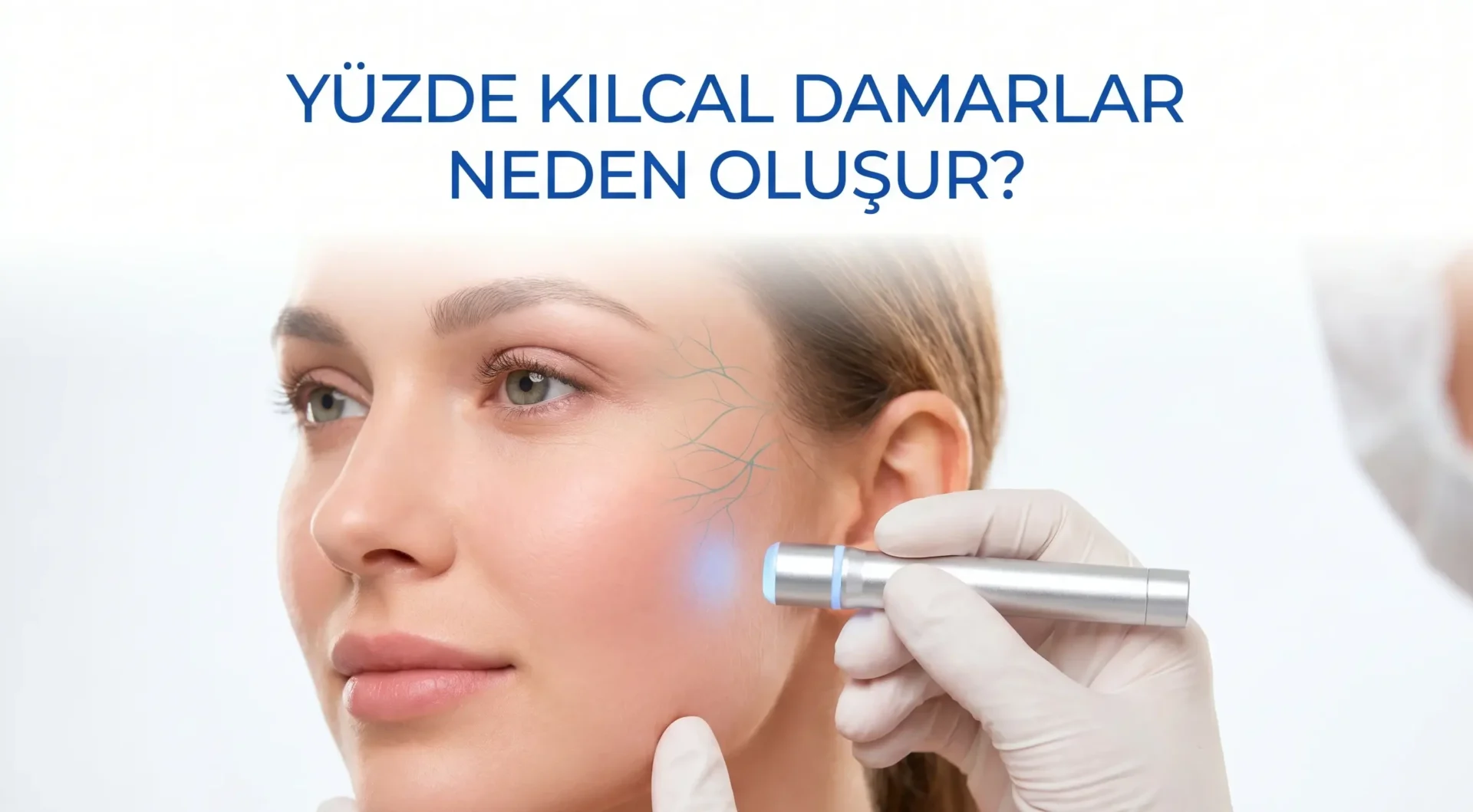
The majority of patients who come to my practice for facial spider veins say something like this: “They’ve been there for years, but lately they’ve become more noticeable.” This observation contains an important piece of information: spider veins don’t appear suddenly, they progress slowly. And when the rate of progression accelerates, there is usually a specific trigger at work.
In this article I want to explain why facial spider veins form, which factors accelerate this process, and what the treatment options are, in the language I use when talking to patients in my clinic.
Facial spider veins can be both a cosmetic concern and a sign of underlying skin sensitivity. Therefore, the question “How can we close these vessels?” is just as important as “Why did these vessels form?” Solving only the first without understanding the second may prove insufficient in the long run.
What Are Facial Spider Veins?
The fine, red, purple, or blue vessels seen on the face are medically defined as telangiectasias. They are formed by dilated small capillaries or small venules that become visible due to their proximity to the skin surface.1
Unlike leg spider veins, those on the face are generally not associated with venous insufficiency. Dermatological and environmental factors are more prominent. They are seen around the nose, on the cheeks and chin, and less frequently on the forehead and temples.
In some patients these vessels may be present at just one or a few points, while a widespread picture can also appear in conjunction with rosacea. Differentiating the two situations is important for the correct treatment plan.
Causes of Formation
A table I frequently discuss with my patients regarding why facial spider veins form:
| Cause | Mechanism of Action |
|---|---|
| Genetic predisposition | Hereditary weakness in vessel wall and connective tissue structure; tendency of capillaries to dilate |
| Sun exposure | UV rays damage dermal collagen and vessel walls; repeated damage leads to permanent dilation of vessels |
| Sudden temperature changes | Hot-cold transitions disrupt the vascular contraction/relaxation cycle; repeated dilation weakens vascular tone |
| Sensitive skin (including rosacea) | Chronic inflammation in the dermis and vascular hyperreactivity; vessels dilate easily and this dilation becomes permanent |
| Estrogen effect | Hormonal changes (pregnancy, hormone therapy) reduce vascular tone; facial vessels may become more prominent |
| Alcohol consumption | Chronic alcohol use chronically dilates facial vessels; can develop into permanent telangiectasia over time |
| Topical corticosteroid use | Prolonged use thins the skin, bringing vessels closer to the surface and making them visible |
None of these factors inevitably leads to a result on its own. But when more than one acts simultaneously, the process accelerates noticeably.1,2
The combination I encounter most frequently in my clinic is: patients with genetically sensitive skin who have not used regular sun protection for many years and have frequent exposure to hot environments (hammam, sauna, hot baths). When these three factors come together, I observe that spider veins develop earlier in life and over a wider area.
Its Relationship with Rosacea
When it comes to facial spider veins, rosacea deserves to be addressed as a separate topic. Rosacea is a chronic skin condition characterized by chronic facial redness, dilated vessels, and sometimes acne-like bumps, with recurring flare-ups.3
A significant proportion of rosacea patients have noticeable facial spider veins. These vessels are a finding of the disease; they can also fuel inflammation and increase the severity of rosacea. According to NHS data, rosacea is more common in fair-skinned individuals of northern European origin, and genetic predisposition is known to play a strong role.4
The treatment of rosacea-related spider veins goes beyond a simple cosmetic approach. Management of triggers (sun, hot drinks, alcohol, hot environments, physical exercise) should be carried out alongside dermatological treatment. Vascular treatment forms one component of this picture and is not sufficient on its own.
For this reason, in patients with facial spider veins on a background of rosacea, I recommend that a dermatological evaluation be performed first, and that vascular treatment be initiated after the underlying inflammation has been brought under control. Vascular treatments applied in the presence of active inflammation may both be less effective and adversely affect the skin healing process.3,4
An observation from my practice: Patients who have not been diagnosed with rosacea but say “My face flushes easily and vessels have appeared”, when they come for examination, I most often find that these two findings coexist. In this case, the treatment plan requires both a dermatological and a vascular surgery perspective.
Difference from Leg Spider Veins
Facial spider veins and leg spider veins may look the same but carry important physiological differences. Understanding this difference is critically important for choosing the correct treatment path.
Leg spider veins (spider veins) are most often connected to a venous pathology. There may be an underlying valvular insufficiency, a feeder vein, or deep venous reflux. For this reason, I recommend a venous assessment before planning spider vein treatment.
In facial spider veins, deep venous pathology is generally not present. The problem is related to variability in the vessel structure at the dermis level. For this reason, the treatment approach is also different:
- While sclerotherapy is the first choice for leg vessels, in the face energy-based methods (laser, radiofrequency) that require more careful control are generally preferred.
- Since facial skin is thinner and more sensitive, application parameters are set differently from leg treatment.
- In facial vessels formed on a rosacea background, closing the vessels alone without managing the underlying inflammation may prove insufficient in the long term.
Treatment Options
Effective and safe methods are currently available for facial spider veins. The choice of the correct method is made according to the size, location, skin type, and accompanying skin condition of the vessel.1
The general categories can be summarized as follows:
- Laser treatment: Light at specific wavelengths targets the red color pigment (oxygenated hemoglobin) and selectively heats the vessel to close it. Minimal effect on surrounding tissue. Particularly suitable for thin superficial vessels.
- Radiofrequency treatment: The vessel wall is damaged using radiofrequency energy to achieve closure. Can also be used for larger-caliber facial vessels.
- Intense pulsed light (IPL): Unlike laser, it uses a broad-spectrum light source. Can be preferred particularly for widespread involvement and surface redness associated with rosacea.
Each method has its own advantages and limitations. Which method is appropriate for you can only be determined after examination and evaluation. I shared more information about this process on the capillary vein treatment page.
The number of sessions and intervals for facial treatment are planned differently from leg treatment. Since facial skin is thinner and the area is more sensitive, sufficient recovery time must pass before the next session. Rather than intervening early, the preferred approach is to take steps gradually while assessing the condition of the skin. The examination during the visit determines the path to follow.
My Protective Recommendations
To slow the progression of existing spider veins and reduce new formations, I recommend the following to patients:
- Adopt a sun protection habit: Broad-spectrum sunscreen of SPF 30 or higher is one of the strongest protectors against facial vessels. UV damage weakens vessel walls cumulatively.2
- Avoid sudden temperature changes: Repeated stress on vessels caused by sudden changes such as entering cold water after a sauna or going out in cold weather in winter.
- Be careful when choosing skincare products: Alcohol-containing tonics, high-concentration acid products, and aggressive mechanical peels irritate sensitive facial vessels.
- Identify rosacea triggers: If facial spider veins exist on a rosacea background, individual triggers (spicy foods, alcohol, extreme weather conditions, stress) should be managed in daily life.3
- Leave topical steroid use under medical supervision: Long-term self-administered topical steroid use can cause facial vessels to become more prominent.
Frequently Asked Questions
Are facial spider veins dangerous?
Not directly dangerous to health. However, if rosacea is present, a dermatological evaluation is recommended as this is a chronic inflammatory process. Vessels can cause cosmetic concern and confidence issues; this is a real quality-of-life matter for the individual.
Do facial spider veins resolve on their own?
No. Spider veins that have once dilated and become permanent do not close spontaneously. Reducing triggers can slow progression but does not eliminate existing vessels. Physical intervention is required for this.
Does rosacea treatment also eliminate spider veins?
Rosacea treatment (antibiotics, topical agents, vasoconstrictive creams such as brimonidine) reduces redness and underlying inflammation, but does not eliminate existing permanent spider veins. Energy-based treatment needs to be applied separately for the vessels themselves.3,4
Does using sunscreen cause existing spider veins to resolve?
No, it does not resolve existing vessels. But it slows the formation of new ones and the progression of existing ones. Sun protection after treatment plays a critical role in preserving results.
How many sessions are needed for facial spider vein treatment?
This depends on the extent of the vessels, skin type, and method. A single session may be sufficient in a limited area, while multiple sessions may be required for widespread involvement. In rosacea, follow-up treatments may be planned more frequently. The number of sessions can only be determined after examination.
For international patients: If you are considering varicose vein treatment in Turkey or facial spider veins treatment Turkey, our İzmir clinic offers comprehensive evaluation and personalized protocols.
References
- Antani MR, Dattilo JB. Varicose Veins. StatPearls, NCBI Bookshelf (updated 2023). https://www.ncbi.nlm.nih.gov/books/NBK470194/
- NHLBI (NIH). Varicose Veins. https://www.nhlbi.nih.gov/health/varicose-veins
- American Academy of Dermatology (AAD). Rosacea Resource Center. https://www.aad.org/public/diseases/rosacea
- NHS. Rosacea (reviewed 2023). https://www.nhs.uk/conditions/rosacea/
- NICE Clinical Guideline CG168. Varicose veins: diagnosis and management (2013). https://www.nice.org.uk/guidance/cg168
Op. Dr. Onur Üstünel
Cardiovascular Surgery Specialist