
What Is the Source Vein in Varicose Veins?

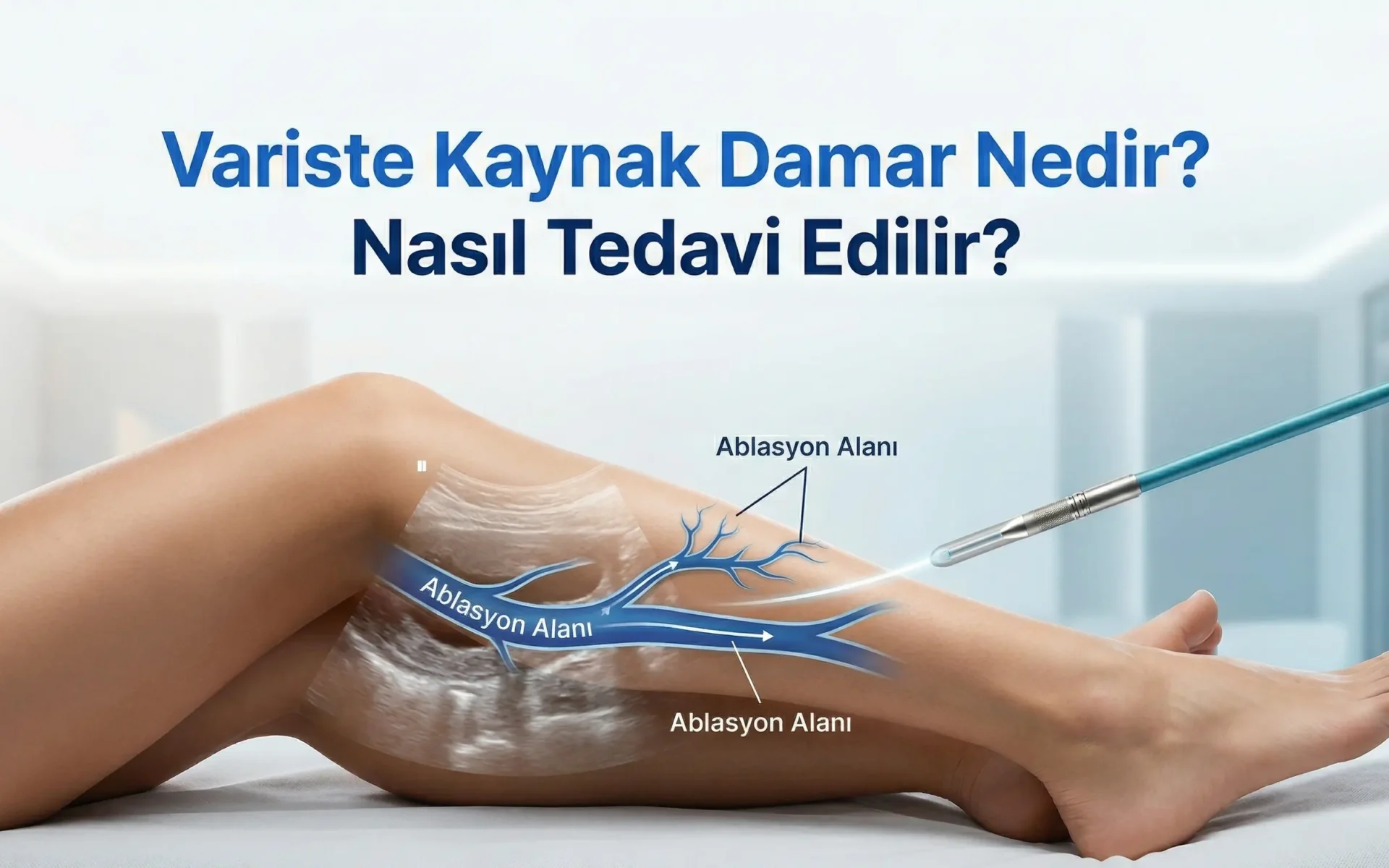
What Are Varicose Veins? Why Look Beneath the Surface?
Contrary to what many people think, varicose veins are not merely an aesthetic problem. The purple or blue, twisted veins that appear on the legs are most often an outward manifestation of a deeper venous insufficiency. The visible part is only the tip of the iceberg.
Veins are responsible for carrying blood from the legs back to the heart. To accomplish this task, small valves exist inside the vessels. These valves ensure that blood flows only upward, toward the heart. However, when these valves lose their function over time, blood begins to flow backward; the pressure inside the vessel rises and the vessels gradually dilate and become deformed. The vessel where this process begins – where valve insufficiency is most prominent – is called the source vein.
What Is the Source Vein?
The source vein is also referred to in Turkish medical literature as the refluxing vein. Blood flow inside a vessel is normally unidirectional: from the leg upward, toward the heart. Valves are the guarantee of this one-way flow. When the valves fail, blood flows back down, in the direction gravity pulls it. This condition is called venous reflux.
The vessel experiencing venous reflux is the main point where the entire system is affected. If this point is not treated, the small vessels treated superficially will soon begin to refill and become visible again. Just as a plumbing problem requires repairing the source rather than the pipe, in varicose veins as well, correctly identifying and treating the source vein is essential for lasting success.
Why Is Treating Only the Visible Veins Not Enough?
This question brings up the most fundamental mistake frequently made in varicose vein treatment. Eliminating varicose veins that have become prominent on the skin surface can provide temporary relief both aesthetically and symptomatically. However, as long as the underlying source vein persists:
- Veins in the treated area may reappear within a short time.
- New varicose veins that were not previously visible may appear in neighboring areas.
- Symptoms such as leg pain, swelling and heaviness continue or recur.
- Since the nutrition of the skin continues to deteriorate, the risk of skin changes or wounds increases in later stages.1
For this reason, the approach in modern vascular surgery has fundamentally changed: First the source vein is identified, then treated with the appropriate method, and finally the superficial veins are addressed. This sequence is critically important for the success of treatment.
I covered the long-term consequences of untreated varicose veins in detail in a separate article. Early diagnosis and source vein treatment significantly expand the treatment options available.
The Importance of Treating the Source Vein
Correctly treating the source vein both provides a significant improvement in symptoms and increases the quality of long-term outcomes. The main advantages of this treatment are summarized below:
| Advantage | Explanation |
|---|---|
| Reduced recurrence rate | When the source vein is closed, the risk of superficial veins refilling is significantly reduced.2 |
| Symptom control | Notable improvement in complaints such as pain, swelling, heaviness and itching. |
| Prevention of complications | Risks of skin changes, pigmentation and deep vein thrombosis are reduced. |
| Treatment completeness | Superficial treatments (sclerotherapy, miniphlebectomy) yield lasting results. |
| Patient satisfaction | Better results are achieved both aesthetically and functionally. |
How Is the Source Vein Identified?
Correctly identifying the source vein shapes the entire treatment plan. The most reliable and standard method used for this purpose is color Doppler ultrasonography.
Color Doppler Ultrasonography
Doppler ultrasound is a non-invasive diagnostic method that uses sound waves to visualize blood flow in vessels in real time. It involves no pain, needles or radiation. During the procedure:
- The direction of blood flow in superficial and deep veins is evaluated.
- Points of valve insufficiency are clearly identified.
- The length and diameter of the refluxing vessel are measured, guiding the choice of treatment method.
- Accompanying conditions such as deep vein thrombosis are excluded.
A Doppler assessment performed by an experienced vascular surgeon both confirms the diagnosis and enables a personalized treatment map to be drawn up. Correct treatment is not possible without correct diagnosis.
Treatment Methods Targeting the Source Vein
Today, there are several effective methods for treating the source vein. Which method will be applied is planned by the specialist physician taking into account the diameter and location of the vessel, the patient’s general health condition, and individual expectations.
Endovenous Laser Ablation (EVLA)
Laser energy applied inside the vessel through a thin fiber closes the source vein through heat. It does not require general anesthesia; the procedure is performed under local anesthesia and the patient can get up the same day. Frequently preferred for great saphenous vein insufficiencies, this method stands out with its high success rates and low complication profile.3
Radiofrequency Ablation (RFA)
In this method, which works on a principle similar to laser ablation, thermal energy is delivered through radiofrequency waves instead of a laser. It is preferred in some patients because it provides more controlled heat distribution. It gives very positive results in terms of both comfort and recovery time.4 You can learn more about the advantages of radiofrequency treatment in our article on radiofrequency treatment advantages.
Sclerotherapy
The sclerosant agent injected into the vessel irritates the inner wall of the vessel, causing it to close over time. While foam sclerotherapy can also be applied to source veins, it is more commonly used in medium- and small-caliber vessels and side branches.
Miniphlebectomy
In this technique, superficial varicose veins are removed through millimeter incisions on the skin. It is used particularly for the treatment of side branch varices that remain after ablation and do not disappear on their own. It can be applied together with or following endovenous methods.
Comparison of Treatment Methods
| Method | Application Area | Anesthesia | Recovery Time | Success Rate |
|---|---|---|---|---|
| EVLA | Great saphenous vein, main trunk vessels | Local | 1-2 days | 93-98%3 |
| RFA | Great/small saphenous vein | Local | 1-2 days | 92-97%4 |
| Sclerotherapy | Medium-small caliber vessels, side branches | Not required | Same day | 80-90% |
| Miniphlebectomy | Superficial varices, side branch vessels | Local | 1-3 days | 95%+ |
What to Consider Before and After Treatment
Some important points before and after source vein treatment directly affect the patient’s recovery process. The use of compression stockings after treatment significantly supports the healing process and contributes to the lasting quality of results.
I also recommend reading our comprehensive guide on varicose vein treatment in Turkey for patients considering treatment options abroad.
Frequently Asked Questions
Is source vein treatment painful?
Modern endovenous methods (laser and radiofrequency ablation) are applied under local anesthesia. Minimal discomfort may be felt during the procedure, but serious pain is not expected. The vast majority of my patients return quickly to their daily activities after the procedure.
Can varicose veins recur after source vein treatment?
When the source vein is correctly identified and successfully closed, the recurrence rate is quite low. However, since venous insufficiency is influenced by genetic predisposition, lifestyle and hormonal factors, the possibility of new reflux developing in different vessels cannot be entirely ruled out. Regular follow-up examinations minimize this risk.
How long does treatment take?
Endovenous laser or radiofrequency ablation takes an average of 30-60 minutes. The patient gets up the same day and can usually return to normal life the next day.
Does every varicose vein require source vein treatment?
No. Capillary varices and some small spider veins can be resolved directly with sclerotherapy or superficial treatments. Source vein treatment is applied in cases where reflux has been detected by Doppler ultrasound. Therefore, correct diagnosis comes before everything else.
Can I be treated without a Doppler ultrasound?
It is not possible to plan comprehensive varicose vein treatment without a Doppler ultrasound assessment. This examination is essential to determine the location, length and severity of reflux in the source vein. The risk of recurrence increases significantly in treatments performed without this assessment.
Conclusion: Correct Treatment Starts with the Right Beginning
Long-term success in varicose vein treatment is only possible not by merely eliminating the visible veins, but by correctly identifying and treating the true source of the disease. The concept of the source vein occupies a central place in modern vascular surgery and forms the foundation of all treatment planning.
If you are experiencing varicose vein complaints, if pain, swelling or heaviness is catching your attention, or if varicose veins have recurred after your current treatment, a comprehensive Doppler ultrasound assessment and specialist examination to create a personalized treatment plan is important.
In my clinic, I observe in my patients that source vein treatment, when properly planned, delivers both functional and aesthetic improvements that last for years. Every patient is different; therefore, every treatment plan must also be personalized.
For international patients: If you are considering varicose vein treatment in Turkey, our İzmir clinic offers comprehensive vascular surgery evaluation including Doppler ultrasound mapping and source vein treatment with EVLA, RFA, and sclerotherapy. Learn more about vascular surgery in Turkey and our approach to long-term results. Visit our treatment overview for detailed protocols and pricing.
References
- National Institute for Health and Care Excellence (NICE). Varicose veins: diagnosis and management. Clinical guideline [CG168]. 2013 (Updated 2020).
- Rasmussen LH, Lawaetz M, Bjoern L, Vennits B, Blemings A, Eklof B. Randomized clinical trial comparing endovenous laser ablation, radiofrequency ablation, foam sclerotherapy and surgical stripping for great saphenous varicose veins. British Journal of Surgery. 2011;98(8):1079-1087.
- Min RJ, Khilnani N, Zimmet SE. Endovenous laser treatment of saphenous vein reflux: long-term results. Journal of Vascular and Interventional Radiology. 2003;14(8):991-996.
- Proebstle TM, Alm BJ, Göckeritz O, et al. Five-year results from the prospective European multicentre cohort study on radiofrequency segmental thermal ablation for incompetent great saphenous veins. British Journal of Surgery. 2015;102(3):212-218.
- Türk Kalp Damar Cerrahisi Derneği (TKDCD). Kronik venöz yetmezlik tanı ve tedavi kılavuzu. 2019.
- American Venous Forum (AVF). Clinical Practice Guidelines: Varicose Veins and Chronic Venous Disease. Journal of Vascular Surgery: Venous and Lymphatic Disorders. 2022.
- World Health Organization (WHO). Cardiovascular diseases fact sheet. 2023.